One of the many changes that I had mentioned in the previous post is the fact that I have moved to an Organic Farm. I had decided to post this later, but seeing as it snuck its way into the HTML address, I thought I'd go ahead with it. I'm in a sweet little house with a sun-room for my art, helping the owners of the property with farm-chores and gearing up for the vegetable season. I'm 15 or 20 minutes from work, having ousted the hour commute from my life. I have a little gym inside the guest-room, with a benchpress, and a place where I can leave my freeweights and kettlebells. I have thousands of acres of core-of-engineer-land to run. I can listen to the forest, its just out the back, past the horses.
There are goats: Yitzy and Yaya, India and Arie. Yitzy hurt her foot the other day. There is a chicken-yard and we get 7-10 eggs a day. There are horses, a pony, two pigs and six dogs.
So here it is: One new adventure, in which I will try my hand at growing things and will be so much more connected to the earth and the sun. I will be the best farm-hand I can be-- and I will become stronger and happier. Here we go, right?
COMING UP SOON: Ode 003, and a new Product Pick
Showing posts with label Urban Homesteading. Show all posts
Showing posts with label Urban Homesteading. Show all posts
Thursday, March 8, 2012

Sunday, September 18, 2011
Using the "Whole Animal," or, Mottainai
Here is a nice story, largely unrelated to the topic at hand. Once upon a time I was chatting with a couple of guests at work. I mused about how giving the coconut palm was, providing vitamins and minerals in the liquid from within the fruit, nutritious and fatty nuts, creamy milk, healthful oil for eating, cleaning and conditioning skin, sennet ('aha') for ropes-- well, I digress, but needless to say I have a great respect for the tree. They told me about the coconut palm in their culture, being from Mangolore, and the Kalpa Vriksha. The Kalpa Vriksha is, as many western cultures might call it, a Tree of Life. They said that they called the coconut palm that because it was all-giving and all-providing.
That got me thinking, later, about the way in which plants and animals provide for the people to live. In a way, I believe that much of what we consume from can be considered all-giving, if we are only all-accepting.
In Japan, the concept of Mottainai is the idea of simply not being wasteful. I learned 'Mottainai' a long, long time ago-- I'm not sure from who or why or how, but I remember the following, about the Mottainai Obake.
And f you are awesome (or 8), you could also watch this video. Anyhow, I remember vaguely the concept being described to me as "what old men say when you throw away a sandwich." I did a heap of studying about the concept, and old Japanese traditions (such as furoshiki, an all-purpose Japanese bandana) and even did my final project for my Japanese Minor on it.
Eventually I come to this: I believe in using as much of everything as possible. One thing feeds the next thing and everything is a cycle. This cycle is so vital to life and living and being and growing-- an entirely captivating and rhythmic system that seems to be have been choreographed by necessity and currently carried out only as novelty. The entire process of cutting and peeling vegetables, discarding large parts of them, and (oh no!) throwing out the 'less enjoyed' parts of animals just makes me so sad inside. Learn about the different nutrients in the leaves, roots, stems, seeds, and fruits. Learn about how giving the bones and organs of an animal can be.
I try my hardest to wring two or three uses out of things. Yesterdays dressing is today's marinade, last night's leftovers are this morning's omelette, and the drippings from that meat will cook the next batch of veggies. Yogurt drains out whey and you can make fermented vegetables, chock-full of probiotics, from that (as the yogurt enables you to make the next batch of yogurt!). Since I was little, I saved papaya seeds as pepper (not knowing about how rich in enzymes they were!) and planted all (to my parents dismay?) my fruit seeds.
Stock is a good place to start: Vegetable peelings and stubs can get thrown into the freezer and collect in a bag. The stems of your herbs and the heads and shells of your shrimps are almost as valuable as the initial foods were. Buy a whole chicken and roast it, then pick it clean and save the carcass. Make a stock from it. Slow-cook your ribs or roasts and save those bones. Make a stock from them. When its time to boil (er, almost boil) those meaty discards, add your frozen carrot peelings and parsley stems. Add your celery and onion butts! I could make an entire blog about stock making alone, so I'll leave you with those tips and urge you to explore the world of stockmaking from one of the many masters.
You can throw the tops of carrots into salads or anywhere you'd use parsley. Radish tops make a mean pesto and the white tails of green onions can grow you more green onions simply by trimming the roots and placing them in fresh water in a sunny spot. In looking through old cookbooks in my dear grandmother's house, I found a very simple recipe that is perfectly in keeping with this subject. I invite you to try it and I'll try it too. It is so simple, in fact, that I don't even believe it has a name (or that people actually need a recipe for it), but sometimes it is nice to see something in old print and pass it on. It makes it a little bit more real, and a little bit more like it is part of that cycle.
Happy eating.
That got me thinking, later, about the way in which plants and animals provide for the people to live. In a way, I believe that much of what we consume from can be considered all-giving, if we are only all-accepting.
In Japan, the concept of Mottainai is the idea of simply not being wasteful. I learned 'Mottainai' a long, long time ago-- I'm not sure from who or why or how, but I remember the following, about the Mottainai Obake.
And f you are awesome (or 8), you could also watch this video. Anyhow, I remember vaguely the concept being described to me as "what old men say when you throw away a sandwich." I did a heap of studying about the concept, and old Japanese traditions (such as furoshiki, an all-purpose Japanese bandana) and even did my final project for my Japanese Minor on it.
Eventually I come to this: I believe in using as much of everything as possible. One thing feeds the next thing and everything is a cycle. This cycle is so vital to life and living and being and growing-- an entirely captivating and rhythmic system that seems to be have been choreographed by necessity and currently carried out only as novelty. The entire process of cutting and peeling vegetables, discarding large parts of them, and (oh no!) throwing out the 'less enjoyed' parts of animals just makes me so sad inside. Learn about the different nutrients in the leaves, roots, stems, seeds, and fruits. Learn about how giving the bones and organs of an animal can be.
I try my hardest to wring two or three uses out of things. Yesterdays dressing is today's marinade, last night's leftovers are this morning's omelette, and the drippings from that meat will cook the next batch of veggies. Yogurt drains out whey and you can make fermented vegetables, chock-full of probiotics, from that (as the yogurt enables you to make the next batch of yogurt!). Since I was little, I saved papaya seeds as pepper (not knowing about how rich in enzymes they were!) and planted all (to my parents dismay?) my fruit seeds.
Stock is a good place to start: Vegetable peelings and stubs can get thrown into the freezer and collect in a bag. The stems of your herbs and the heads and shells of your shrimps are almost as valuable as the initial foods were. Buy a whole chicken and roast it, then pick it clean and save the carcass. Make a stock from it. Slow-cook your ribs or roasts and save those bones. Make a stock from them. When its time to boil (er, almost boil) those meaty discards, add your frozen carrot peelings and parsley stems. Add your celery and onion butts! I could make an entire blog about stock making alone, so I'll leave you with those tips and urge you to explore the world of stockmaking from one of the many masters.
You can throw the tops of carrots into salads or anywhere you'd use parsley. Radish tops make a mean pesto and the white tails of green onions can grow you more green onions simply by trimming the roots and placing them in fresh water in a sunny spot. In looking through old cookbooks in my dear grandmother's house, I found a very simple recipe that is perfectly in keeping with this subject. I invite you to try it and I'll try it too. It is so simple, in fact, that I don't even believe it has a name (or that people actually need a recipe for it), but sometimes it is nice to see something in old print and pass it on. It makes it a little bit more real, and a little bit more like it is part of that cycle.
BEET GREENS FIESOLE from Fresh-from-the-Garden Cookbookby Miriam B. LooThanks for stickin' around. Let me know if you try it!
1 lb beet greens, washed and trimmed
2 cloves garlic, minced
3 TB olive oil
Salt and freshly ground pepper to taste
Cook beet greens in salted boiling water until just tender, about 7 minutes. Drain well, pressing greens to sides of colander or sieve to remove all moisture. In a medium-size skillet, sauté garlic in olive oil until just brown, about 1 minute. Add beet greens; mix well. Add salt and pepper to taste. Heat greens through. Serve immediately.
Serves 4.
Happy eating.
Tuesday, May 24, 2011
The Return of the Bento
Once upon a time in a kitchen far far away, I began a blog to showcase the bento boxes that I thrived on. Much of my life and beliefs have changed, but some things remain the same: I love food and I love bento.
Bento boxes and all their little toys and cups excite me and make lunch that much more special. Though I'm certainly not afraid to dump good ingredients into a bowl and happily devour, there is something entirely special about cracking the lids of an artfully arranged, delicately balanced little lunch. Bento boxes allow for a sort of break in your day that removes you from the sit-and-scarf catches of 30 minute work breaks. They seem to be something of a culinary breath.
Admitedly, I've not been attentively documenting or sharing my bento boxes with you so much anymore (sorry, if you need emotional support let me know), but I'm leaning to change that. Please, enjoy my bento.

As I ate this, I began to realize something. As a normal part of my life, I make a lot of things from scratch. I don't think about it, I don't make an effort to do it. I have simply become a person that does this. The egg salad was made from eggs that I get directly from the chicken farmer locally, made with my homemade mayonnaise, and included chives that I grew and pickles that I had fermented and chopped into relish myself. Crazy? It seems to be regarded as a little bit crazy.
Monday, April 25, 2011
Home Cured Bacon

edit: Alright, since DeusInvictus so quickly (and desperately!) replied, I'll give a synopsis of The Baconing. And first, to answer the question of description: Meaty, spiced, peppery, smoky, and mildly sweet. It will indeed make you sway. It didn't uniformly crisp up like I like, but that can be easily solved by getting it cut more thinly.* Unfortunately, since I cannot recover that post, it won't be exact-- but I can remember the gist of it.
Essentially, home 'curing**' bacon is simply marinating pork-belly in salt and spices until it is 'cured,' in the same way that one (if one were smart and wonderful) would make salted salmon for Lomilomi Salmon (salt, wait, wash). If you didn't understand the things that I just mentioned, just move on. There is still hope for you.
My dad is a genius of smoking. Not that my father has a cigarette between every finger or a special cigar-smoking device-- not that at all. Silly-wicket. My father built a magnificent smoker out of a propane tank long long ago, welding huge sheets of steel into a magical sculpture that transforms raw meat into charred treasure. My favorite times, as a child, involved being treated to 'the heel' of the brisket, in its black crusty goodness, with a tender line of pink meat just underneath. He'd fire it up only when he'd stocked up on an entire petting-zoo worth of meat and could fill it (and the oven on the end) to the brim. I have fond memories of a clean bathtub full of raw briskets thawing in the front bathroom (how very strange). It fed us, and many other family and friends, for months.
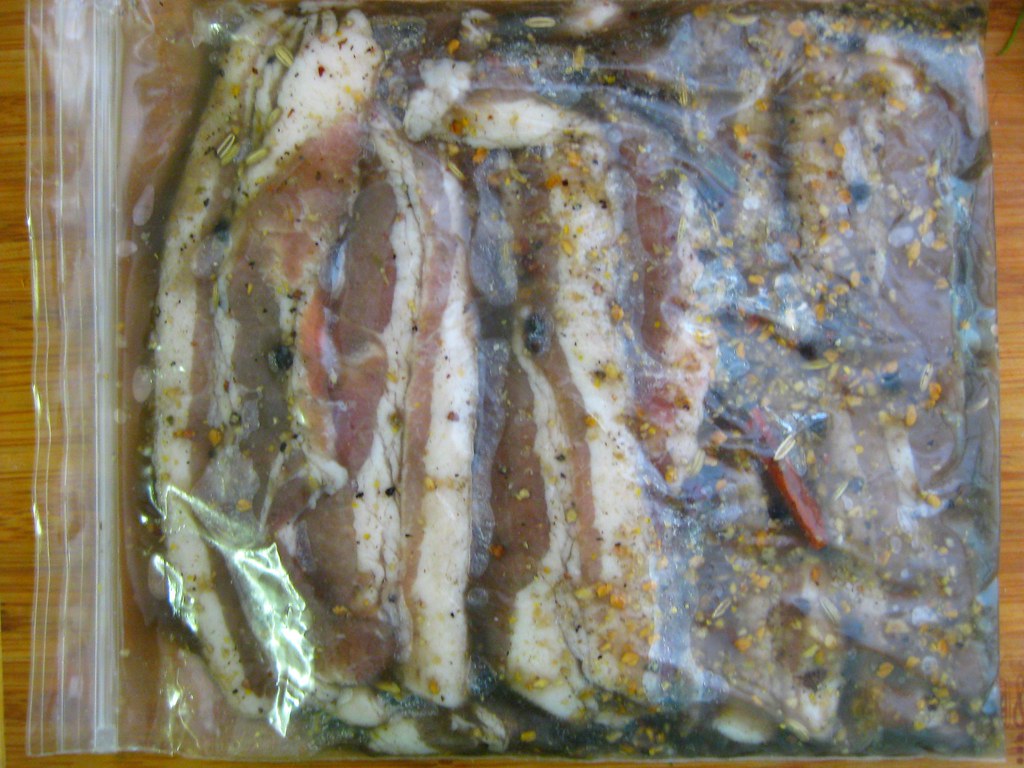 However, a smoker I have not. It would be efficient for me, at least right now. A few years ago, I shared my knowledge of liquid smoke making with my dad and he bestowed unto me a bottle of home-made liquid smoke. OK, we're back to bacon. Seriously, I took the scenic route to get here. Simply purchase pork belly from your meat market and place it flat in a ziploc bag with a 1/2 cup (ish) of liquid smoke, some small cinnamon sticks, whole black peppercorns, salish alderwood smoked salt, fennel seeds, and SO importantly: ground Fenugreek. Fenugreek is an intoxicating, mellow spice, reminiscent of maple syrup. Lay this bag of goodies (after mixing well) flat on a shelf in the fridge and flip it every day for seven days. When you're done, take the
 Now, there you have it. Place sheets of wax paper between them and put them in a baggy to use or freeze! Congratulations, bacon-maker. You win breakfast.
Happy eating!
*I'm going to try this next time using unsliced pork-belly. This time I used slices, as seen in the picture below.
**I don't claim to use the word 'curing' in any sort of scientific way. I don't know what that actually entails, alright? Back off!
Saturday, April 2, 2011
Eat Safe, Use Condiments.
Oh, how uncomfortably stupid, the title of this post. Sauces and dips of all kinds have been on my mind as of late, and while insubstantial to really make up a post (or meal) I believe I've accumulated enough to create a little substance (or meal).
Dakine Dressing
This 'Asian-esque' dressing is one of my favorite little creations! It is an amazing, thick, light tasting dressing that is translucent and beautiful. I usually just make salad dressing on a whim for my meal, eat, and move on-- but this was so good that I scrambled to remember what went into it and how much--ish. I'm glad-- because it has definitely become one of my favorite refrigerator staples. And, wonder of wonders, it doesn't separate!
Dakine Dressing
This 'Asian-esque' dressing is one of my favorite little creations! It is an amazing, thick, light tasting dressing that is translucent and beautiful. I usually just make salad dressing on a whim for my meal, eat, and move on-- but this was so good that I scrambled to remember what went into it and how much--ish. I'm glad-- because it has definitely become one of my favorite refrigerator staples. And, wonder of wonders, it doesn't separate!
1 TB Sunflower Butter
1 TB Mac Nut Oil
1 tsp Ginger Juice
1 tsp Coconut Vinegar
1 tsp coconut Shoyu
1/2 tsp Sesame Oil
Big Pinch of White Pepper
Big Pinch of Orange Zest
Big Pinch of Dulse Flakes
Big Pinch of Red Pepper Flakes
Small Pinch of Strong Cinnamon
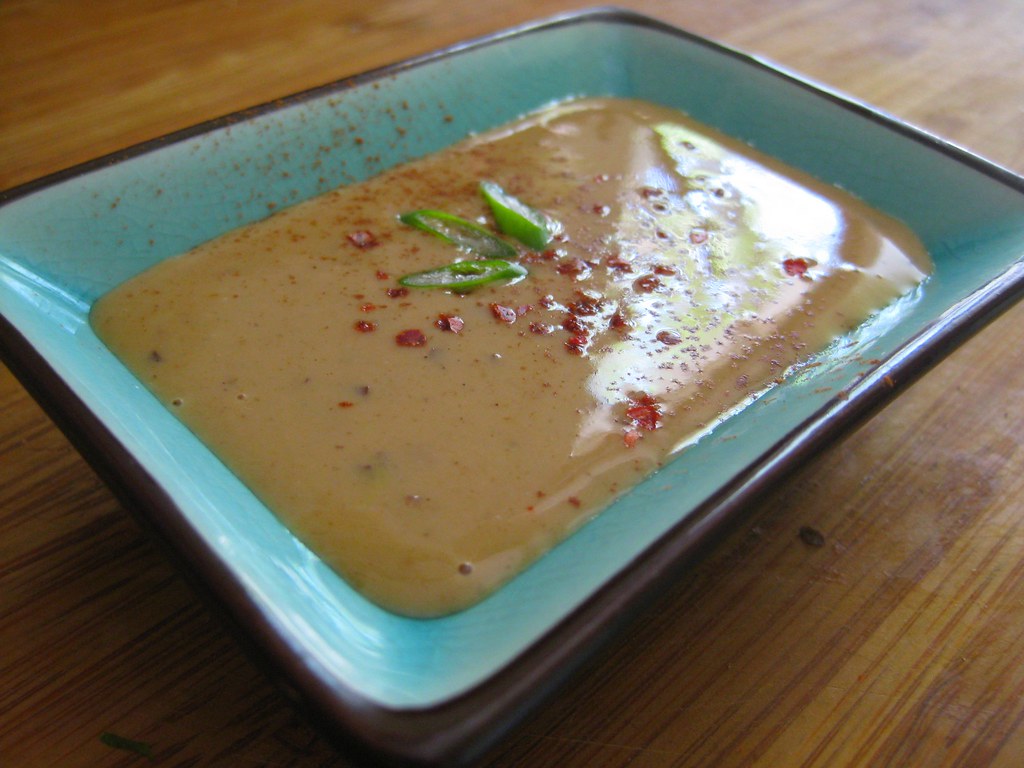
Whisk together and store in an adorable glass jar in the fridge. This makes two or three...ish.. servings.
Hamburger Dressing
Assuming that your mom (swell lady that she is) has gifted you some home-made bacon-mayonnaise, you're ready to go. Otherwise, make it. I didn't like bacon mayonnaise much before I tried it in this way-- then things got REAL. Mix 1 part mustard, 1 part ketchup (check out the link at the end!), 1 part bacon-mayo, 1 part olive oil, and 1 part (apple cider or white wine is good) vinegar. Add a little bit of dry dill leaf (or pickle relish). Whisk it together... aaaand done.
Tahini Dressing
Easy dressing that I learned from the owner of Milk And Honey, my favorite little Israel shop in Dallas. Eh, Richardson? Hm. I remember when I was younger cooking a big passover dinner for my family that we all enjoyed on tables out back, and I remember how jazzed I was-- delighted, really-- that my dad seemed to really love this dressing. Anyhow, back to the shop and Richardson and the recipe. They said simply say to mix tahini with water. That's it. Thats all, and you know, some lemon juice. Thats all it takes, with garlic powder, salt, and pepper. That's all. That's what they said, that's how they said it. And they are right. You want I should make it?
______________
A Little Lagniappe:
Mustard Vinaigrette. The salad itself is AWESOME too-- Bacon and Egg salad? Rugged ingredients, yet elegant presentation. Its a classic French salad, the Salad of Burgundy. Between the glory that is a Burgundy Salad and the heaven that comes in the form of Niçoise salad, methinks the French know their salads. (Me also thinks that the rest of the world knows their salads perhaps a little bit better than America, the beautiful.)
Fermented Ketchup. I omitted any added sweet (duh?) as tomatoes have enough sugar on their own. I used raw goat milk whey that was leftover from my yogurt making. I didn't bother straining it, so it does have a spreadable pastiness to it. I am probably going to use this recipe next time, as I think that the anchovies/fish sauce are a very important part of making ketchup.
Hamburger Dressing
Assuming that your mom (swell lady that she is) has gifted you some home-made bacon-mayonnaise, you're ready to go. Otherwise, make it. I didn't like bacon mayonnaise much before I tried it in this way-- then things got REAL. Mix 1 part mustard, 1 part ketchup (check out the link at the end!), 1 part bacon-mayo, 1 part olive oil, and 1 part (apple cider or white wine is good) vinegar. Add a little bit of dry dill leaf (or pickle relish). Whisk it together... aaaand done.
Tahini Dressing
Easy dressing that I learned from the owner of Milk And Honey, my favorite little Israel shop in Dallas. Eh, Richardson? Hm. I remember when I was younger cooking a big passover dinner for my family that we all enjoyed on tables out back, and I remember how jazzed I was-- delighted, really-- that my dad seemed to really love this dressing. Anyhow, back to the shop and Richardson and the recipe. They said simply say to mix tahini with water. That's it. Thats all, and you know, some lemon juice. Thats all it takes, with garlic powder, salt, and pepper. That's all. That's what they said, that's how they said it. And they are right. You want I should make it?
Coconut Sour Cream
I really just didn't have sour cream and had a lot of coconut powder laying around. Why not make coconut cream and sour it with vinegar?
I really just didn't have sour cream and had a lot of coconut powder laying around. Why not make coconut cream and sour it with vinegar?
4 TB Powdered Coconut Milk
1/2 TB Coconut Vinegar (or White Wine Vinegar)
1 TB whey (I used raw goat's milk whey from yogurt-making)
Good Salt
A bit of warm water (1 or 2 TB)
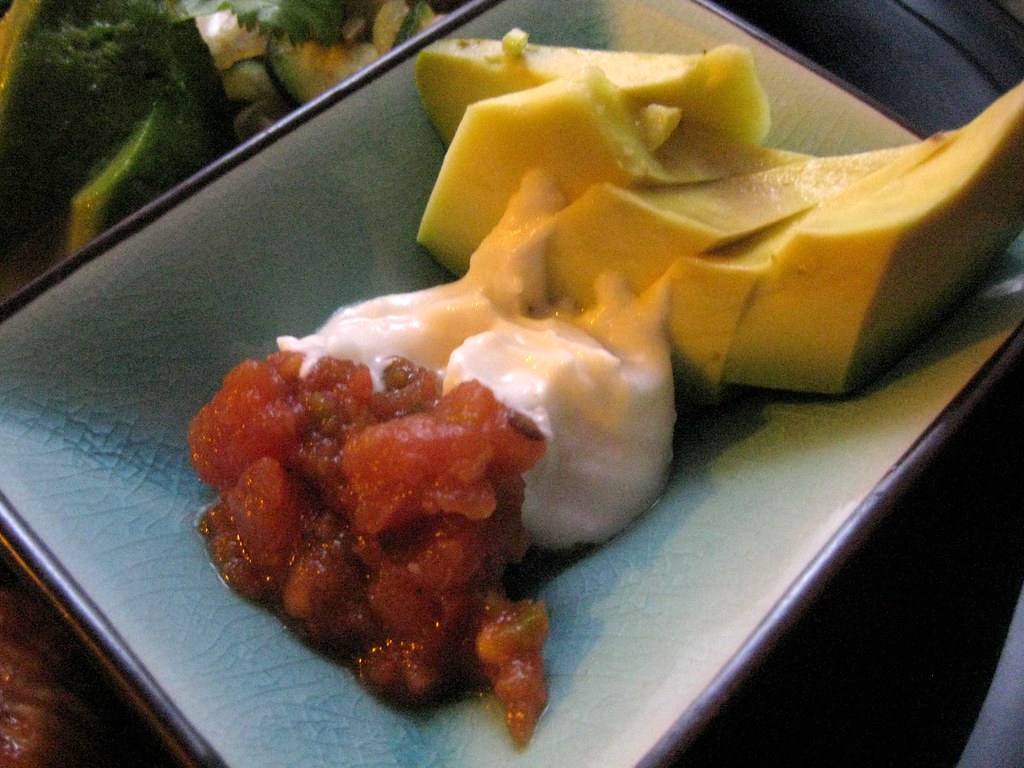
Put the powdered coconut milk in a mixing bowl and add just enough warm water so that you can start whisking it with a fork. Using an actual whisk at this stage makes it lumpy and messy, so use your fork and make it metal. Stir and whisk until it is really thick-- thicker than sour cream-- and add your vinegar and salt. Whisk together and leave out on the counter overnight. This tastes VERY coconutty-- in fact, I added some olive oil before putting it in the fridge to bring down that natural 'sweetness' a bit-- but its delicious and adds an entirely exotic whirl to anything you'd add sour cream to. I added the whey with the intention of allowing it to ferment, but I don't think it did anything and it probably isn't necessary.
______________
A Little Lagniappe:
Mustard Vinaigrette. The salad itself is AWESOME too-- Bacon and Egg salad? Rugged ingredients, yet elegant presentation. Its a classic French salad, the Salad of Burgundy. Between the glory that is a Burgundy Salad and the heaven that comes in the form of Niçoise salad, methinks the French know their salads. (Me also thinks that the rest of the world knows their salads perhaps a little bit better than America, the beautiful.)
Fermented Ketchup. I omitted any added sweet (duh?) as tomatoes have enough sugar on their own. I used raw goat milk whey that was leftover from my yogurt making. I didn't bother straining it, so it does have a spreadable pastiness to it. I am probably going to use this recipe next time, as I think that the anchovies/fish sauce are a very important part of making ketchup.
Friday, March 25, 2011
Foraged! Found Food (and some found links)
A few links:
These people take food presentation and photography to an entirely different level of artistic beauty.
I made Adobong Pusit Sa Gata from 'Home Cooking Rocks' and I have GOT to reccommend it. Next I plan on making their Mushrooms, and I suggest you follow suit. This site is full of deliciousness, and is very primally workable.
Good News--- the bee hive found recently in the walls of my alma mater is being given a chance at survival! Or, at least, delayed execution. Its said to contain something like HALF THE BEES IN NORTH TEXAS.
_____________________

Eating for free is an alluring idea. Pair it with the romanticism of a whimsical stroll through a sunny field and you have created my Thursday-- and my salad. OK, maybe not really. Maybe you've just imagined my salad's accent-- scant seasoning-- whisper of--... alright, so not much. But the point isn't the AMOUNT of food-- it is that I danced (uh, stomped) through a grassy Texas field and found food!
I was told there was wild asparagus growing in a certain area by an amazing friend (Jim, the patriarch of my "Denton Family*). I made my way to where I thought he meant, found a place a few blocks away to park, and made my way over with little more than a bandana to carry my findings in and a car key. Not even my camera came. Dry yellow grass up to my knees and brush collecting in my Vibrams, I followed a kind of old path and wound around the entire property finding nothing that looked even remotely vegetable-like. The grasses I saw I knew of as different spring onions (three, actually) and I plucked a few, but wandered with growing disappointment toward the stalks that seemed to never come. Instead of taking a logical path around the back of the property (hours later), I decided to cut straight through the overgrown middle.
There amongst the grasses, in their yellow-green frailty, I saw them. How and why I spotted them as I traipzed on past, I don't know-- but there they swayed.
ASPARAGUS!
I plucked a few and left more so they could grow into something more substantial later on.
I think I'll toss them in vinaigrette and top my salmon with them.
Happy Eating!
*Bios to come later, after my Primal Birthday Revamp. TOMORROW!
Subscribe to:
Posts (Atom)